
Lectures
Keith McCuaig is a part-time professor at the University of Ottawa; has taught 40+ courses through Carleton University’s Lifelong Learning Program; and has presented at international musicology conferences. From performing and giving music lessons, to lecturing and working with Ottawa Bluesfest’s community programs, Keith’s life and passion is music.
More info: keithmccuaig.com
-

November-December: Actively Listening to Music Part 1
Dates: November 5-December 10
Time: Thursdays 1:00-3:00pm
Cost: $175This course will help to fine tune your ears and develop strong listening abilities. Learn about musical forms like the 12-bar blues and 32-bar chorus form, and how to identify individual instruments through sound. A wide variety of popular music genres will be covered including rock, pop, blues, country, R&B, reggae and more. The ultimate goal of this course is to increase your enjoyment of music through a greater understanding of what you are hearing. Our analyses will not be overly technical, and you don’t need to have a musical background; all you need is a love of music.
By the end of this course, participants will:
Understand more about musical forms and structures
Be increasingly able to identify by ear, and classify a variety of instruments
Appreciate music in new ways
Note: This is one of two music appreciation/listening courses that I teach (the other, “Actively Listening to Music, Part 2” was offered in previous sessions). This is an independent lecture series, distinct from the earlier session. If you enjoyed “Actively Listening to Music, Part 2” you will enjoy this series as well; however, knowledge of material from the previous course is not required.
Week 1:
To begin our journey in better understanding music, we’ll start with the concept of active listening vs. passive hearing. Several basic music terms will be discussed, with plenty of examples, including rhythm, metre, pitch, harmony, melody, and musical texture.Week 2:
This week is an exploration of various musical forms, or structures. Identifying various parts of a song or musical work (the formal structure) is important in understanding music, and it’s also really fun! We’ll look at and listen to simpler musical forms like verse-chorus, 12-bar blues, 32-bar chorus form, and more complex structures that include a bridge, pre-chorus, outro, and more.Week 3:
Tone colour, or timbre, is a term used to describe how an instrument sounds. We’ll look at the five categories of instrument classification, with plenty of examples. The selection of instruments is eclectic and includes some lesser-known ones, and a few from outside the Western musical tradition. Understanding how an instrument works, in addition to how it sounds, helps us to identify instruments by ear. First, a variety of wind instruments (classified as aerophones), including saxophones, trumpet, trombone, harmonica, siku panpipes, and the pipe organ.Week 4:
Continuing with categories of musical instruments, next up is stringed instruments (classified as chordophones). We’ll look at more familiar instruments (violin/fiddle, electric bass, and pedal steel guitar), and some that may be less familiar (santur, pipa, balalaika, hurdy gurdy, and kora). Our third category is membranophones (instruments with a drum head), including the drum kit, darbuka, djembe, conga, and da-daiko.
Week 5:
This week we’ll learn about percussion instruments (ideophones), and we’ll discuss the vibraphone, cowbell, and mbira. The final category of the instrument section is electrophones, including theremin, electric organ, electric piano, synthesizers, samplers, drum machines, and turntables.Week 6:
In the final week of this course, we will explore some commonly used effects, such as reverb, delay, distortion, wah-wah, tremolo and more. Finally, a look at a few other unusual instruments/effects including the talk box and vocoder. -
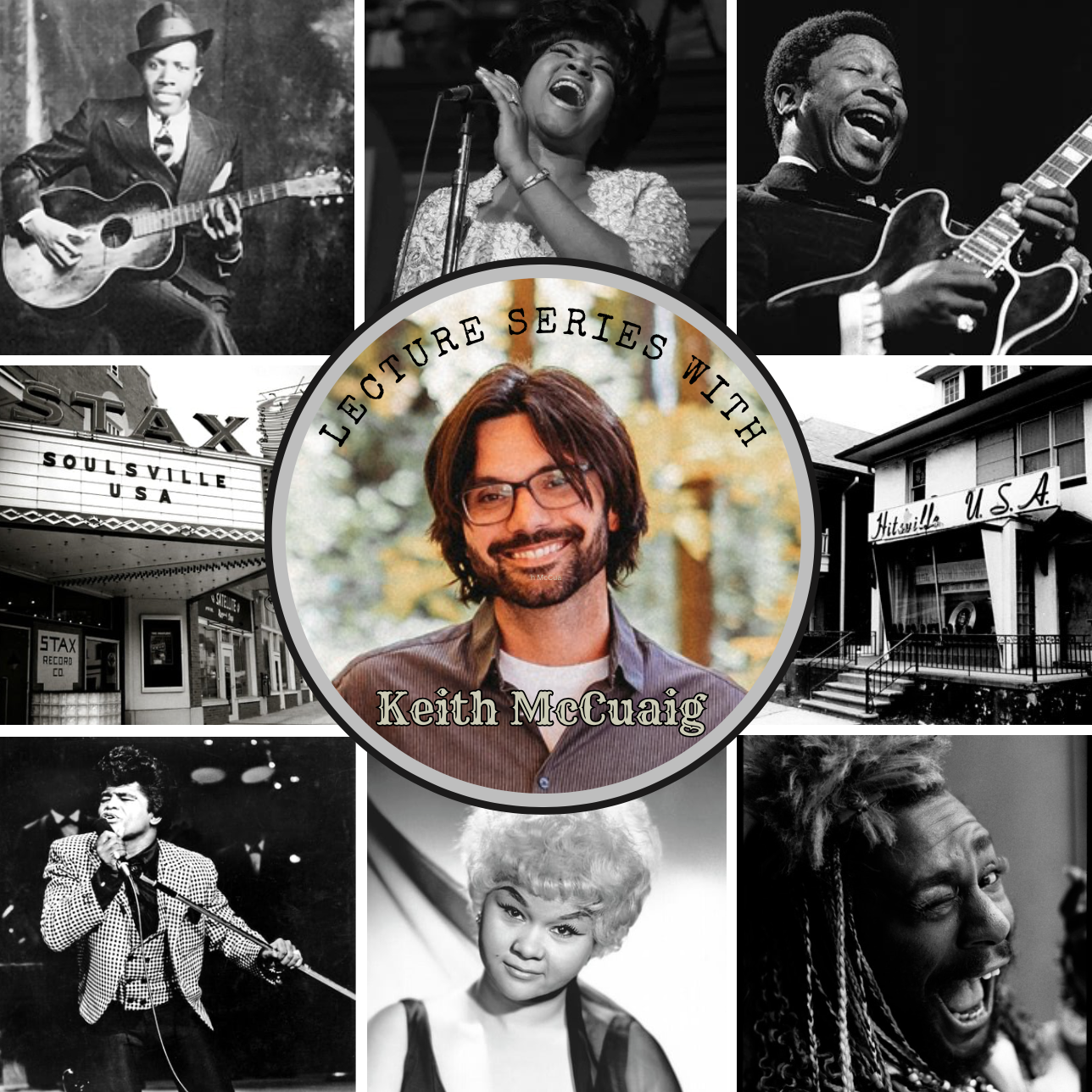
September-October: African American music 1940s-1970s: blues, soul and funk
Dates: September 17-October 22
Time: Thursdays 1:00-3:00pm
Cost: $175This course will give an overview of some of the most popular musical genres from the 1940s to the 1970s, including the main figures, important recordings, and the musical features of each style. The cultural importance and impact of this music will also be discussed, including the overlap between these genres, and the ways in which one genre influenced another. From Muddy Waters and Marvin Gaye to Aretha Franklin and James Brown, this class will be an exciting musical journey.
Schedule of topics:Week 1:
This course starts with early African American music, including work songs and minstrelsy, which provides some socio-cultural and musical context for the next six weeks. The blues is the first major topic, and we'll look at musical and lyrical features of this style, as well as the 12-bar blues form. The first blues style to examine is acoustic blues of the Mississippi delta (Charley Patton, Robert Johnson), and its transformation into the electric Chicago blues (Muddy Waters, Howlin' Wolf).Week 2:
Continuing with the blues, we'll look at some of the earliest records sold as blues, which are the "classic blues" of Bessie Smith. The variety continues with the big band jazzy blues of T-Bone Walker and BB King, and two regional varieties: Texas blues, and Piedmont blues.Week 3:
To finish up the blues section we have a variety of artists including Leadbelly, John Lee Hooker, Buddy Guy, and the 60s folk blues revival. Next, we'll examine some 1950s R&B styles, including jump blues (Louis Jordan), and sweet soul (The Drifters). Gospel is the last topic of the week, where we'll look at early vocal groups, the Staple Singers, and the Reverend CL Franklin.Week 4:
This week is all about soul. Some of the earliest singers to combine elements of the sacred and profane, gospel and R&B, were Ray Charles and Sam Cooke. Our breakdown of the many regional soul record labels begins in Detroit with a detailed look at Motown (The Temptations, The Supremes, Marvin Gaye, Stevie Wonder, Jackson 5)Week 5:
Continuing with the regional soul labels, we'll go to Memphis for Stax Records (Otis Redding; Booker T & the MGs; Isaac Hayes), and Hi Records (Al Green). Next, Muscle Shoals, Alabama, which is home to FAME studios and the Muscle Shoals sound (Aretha Franklin). We'll wrap up the soul section with a look at some of the 60s and 70s soul sounds coming out of New Orleans and Chicago.Week 6:
James Brown and his band are widely credited with creating funk in the mid-1960s. We'll look at how funk emphasizes the African as opposed to the European elements of soul music. There were changes to funk in the 1970s, exemplified by George Clinton and Parliament; Sly Stone and the Family Band; Kool & the Gang; and the Meters. Finally, a brief look at how funk, along with the Philadelphia sound, leads into early disco.